• https://tomclausen.wordpress.com/
  • Mann Library reading 4-21-09

tom clausen

~ poems and photos

Category Archives: Tom poems at other sites

selections of my poems found at other sites

From Conflict to Poetry – tom clausen

16 Monday Nov 2026

Posted by Tom Clausen in americana, Favorite Haiku, haiku, nature, Published Poems, Readings, senryu, Tom Clausen biographical info, Tom poems at other sites

≈ Leave a comment

Tags

nature, poems, poetry, Ithaca, haiku, writing, poem, From Conflict to Poetry

This was published in Simply Haiku in the Summer of 2005 -v.3 no.2

Feature ~Tom Clausen
From Conflict to Poetry
Some days, sometimes, life becomes an unfortunate series of conflicts. I would like to examine how conflict in our lives might inspire us to read and write haiku and other short poetic forms. I believe turning to these forms as a response to conflict creates for us an opportunity both to lose and find our selves, as well as to gain some resolution, levity and redemptive understanding. Conflict in our lives, as I’m sure everyone here can attest, is epidemic. It can range from the petty, everyday variety to the profound, deeply unsettling type of conflict that makes our very existence miserable.


The list of how we define conflict is as endless as the days and the lives of those experiencing these conflicts. In examining the self, it becomes apparent that conflict creates in us incentive and impetus to recreate our reality or at least to adjust our understanding of reality. In a critical sense, it is conflict which challenges and upsets our old, comfortable self-understanding. This may lead to a reconfiguring of the self which in essence we have merely invented as a reflex and reaction to the myriad circumstances, needs and desires we experience daily. The chameleon of our self usually remains beyond the conscious control, unless of course we are a saint, a Zen monk or in some other way tremendously disciplined in the ways of the self.


As we go along in life we cling to this self like a life preserver. After awhile we may begin to recognize that the self, like all forms in nature, is subject to change and extinction. Carrying identities and shedding them like snakeskins is a lifelong and humbling negotiation beginning on the playground and requiring each of us to close down and let go of significant parts and ideas we have of our self all along the way. Yet, combined with these losses, may come the discovery that a certain currency of self exists in concert and unity with all things, great and small, simple and complex. This currency always exists but may be only discovered and intelligible when we feel deeply the wheel of our life turning so that we begin to look, listen, and notice our ‘self’ with extra-sensory interest and attention. It is at such times of awakening, often in the midst of conflict, that our perception to receive poetic messages opens. These messages visit us with heart lasting truth and insight which may dissolve as quickly as it arrives. Haiku are from this realm, and the best of haiku give us glimpses at a uniquely clear and liberated relation to our sometimes imprisoning and limited alone little self.


As writers we have two main paths of response to our conflicts:

1. We can directly confront our conflicts by cathartically writing about them and in the process gaining both perspective and distance which in turn, often provides levity. I often favor this approach and have found a healthy degree of self therapy is available by simply reporting on the essence and edge of my conflicts, aware that they are as likely to be universal as they are unique. As the Buddha pointed out, there is not one house that does not experience struggles and suffering. When we share and find ways to help each other bear burdens, we begin on a path of liberation even if in our writing we feel as if we are simply walking in place!

2. The second path is to seek alternative reality by choosing to contact apart or a level in the self that is not feeling conflicted. In other words, to basically shun and reject conflict in favor of a reality that is at least seemingly, if only temporarily, free from conflict.


This response I liken to the poet in person being much like a dream catcher; catching the burdensome while allowing those joys and affirming visions to pass through. The widely sought serenity that is often equated with nature and nature poems is perhaps the written representation of those who in response to conflict are inspired to focus on images, places and feelings that are not conflicted. I’ve often wondered if the most classically undramatic and still point nature poets are not selectively creating what they as individuals most need as a response to their personal conflicts or those in the world at large. Perhaps as a group, those of us who associate and strongly relate to haiku are doing so as a collective response to a world gone quite mad with too many conflicts.


D. T. Suzuki in his introduction to Essays in Zen Buddhism points out: “life is after all arguing, a painful struggle . . . this however is providential for the more you suffer the deeper grows your character, and with deepening of your character you read the more penetratingly into the secrets of life.” A gift of conflict then, encourages us to read these secrets, and haiku offer a way to articulate and share our findings. Each of us writing haiku and other short forms is as a reporter of sacred and small bits of news about our transitory passage through this mysterious life and world. Conflict is our reality check—our chance to reflect, review, and take time out to look, listen . . . and note! When the poetic and intuitive speaks to us, we become a medium for a message that allows us to be refreshed with seeing anew and again that which simultaneously lets us lose and find our self.


In David Steindl-Rast’s book A Listening Heart, he has an insightful chapter devoted to haiku called “Mirror of the Heart”. In this chapter, he begins by calling haiku a mirror; “Like a crystal, the facets of which mirror and bring together so many different reflections of the world around it, the haiku shows us some important aspects of the world gathered together and reflected as if in one brief sparkling flash. The clarity and precision of this remarkable poetic form is only heightened by the fact that it is so utterly unsentimental. So is a mirror.” As we go about our day to day rhythm of routines, a degree of unconscious-automatic pilot type behavior dims our awareness and attention to see and feel many miracles and poetic messages about us.


The calling of haiku requires of us a daily recognition of moments, simple and subtle as they may be, that rise above the plain of our life and give a good glow of knowing . . . bringing humble grounding and poetic order to the cottage of the self. Brother Steindl-Rast describes this aspect of haiku as a “Peak Experience” . . . “for we do experience our lives as relatively long stretches of ascent and decline culminating here and there in brief moments for which a peak is the perfect image. What makes a Peak Experience so liberating is that precisely for once I no longer feel and know that I know but simply feel and know just that. Only afterwards can I reflect on it and so talk about it. And what I am then inclined to say is something like “I was simply swept off my feet,” or “I was out of myself, carried away.” Even though it might have been for a split second only, “I had lost myself.” This was all. But not quite all. For looking back I will so admit that at the moment of my Peak Experience I was more truly and more fully myself than at any other time. And so I find myself confronted with the strange paradox that I am most truly myself when I forget myself. When I lose myself, I find myself.


To receive and record haiku is a challenge requiring considerable patience and readiness for those moments of serendipity when suddenly like a candid camera we are shown ourself in a most special way. It takes practice and regular reading to discover the breadth and depth of the endless ways haiku can be felt. That conflict and adversity may turn us to writing, is in no small way an honoring of our life and all life and can be the compassionate venture beyond our self on the way to find our self. . . . In Francine Porad’s collection The Perfect Worry Stone, Connie Hutchinson writes in the preface: “Greeks carried “worry stones,” usually agates, in their pockets. Fingering them had a calming effect, reducing anxiety. As haiku poets, we observe the moment, craft the poem. Poet and reader re-experience the moment through the poem. Haiku in all these aspects engage us with life, diverting our attention from ineffectual worry over personal and communal pains, redirecting our thoughts and energies. Haiku is the perfect worry stone. In my life I have found considerable solace in being able to write about my personal conflicts, moments where I felt moved to pause, reflect, regroup and recognize that even in conflict and distress are silver linings and the potential for poetry that each of us can find in our heart . . . and in turn move on from our conflict through the poetry we create from it.~ Tom Clausen
waking me
just to tell me
she can’t sleep


Some poems from my chapbook, published by Snaphot Press in 2000, entitled, Homework:


how long he cries
for the little shell lost
on the way home

**

home from work …
the little one brings me
an empty wine bottle

**

playing a child’s game
I learn all
his rules

**

all through
his temper tantrum
her calm

**

now that I’m over
my bad mood,
she’s in one

**

she’s waited up …
to have some last words
with me

**

while brushing my teeth
she tells me again:
“let’s move”

**

the plumber
kneeling in our tub
– talking to himself

**

done –
the repairman tells me
any fool can do it

**

the snow
moves me
window to window

**

second day
of the New Year:
taxes arrive

**

at the mailbox
the emptiness
of another day

**

outside the glass door
our old cat has forgotten
it wanted “in”


Tom Clausen lives in Ithaca, NY with his wife, Berta Gutierrez, and their son, Casey (16) and daughter, Emma (10), in the same house Tom grew up in. Tom works in a library at Cornell University where he used to post haiku in an elevator for patrons. This has evolved to become a link at the Mann Library home page featuring a daily haiku. He became enchanted with haiku and other short poetic forms in the late 1980s after reading an article about Ruth Yarrow, a fellow Ithacan at the time.Tom has five chapbook collections of haiku and tanka: Autumn Wind in the Cracks, Unraked Leaves, Standing Here, (self published) A Work of Love (Tiny Poems Press) and Homework (Snapshot Press, UK).


A Haiku Way of Life by Tom Clausen

12 Thursday Nov 2026

Posted by Tom Clausen in Favorite Haiku, haiku, Tom Clausen biographical info, Tom poems at other sites, Tom selected favorites

≈ Leave a comment

Tags

9-19-98, haiku, Haiku Society of America, Haiku Way of Life, poem, poems, poetry, reading, Readings, tom clausen, writing

A beginning place for me is to go back to the haiku I read and the various books and
essays about haiku which made indelible impressions and so captivated me at that time.
To this day, the gift and sense of those earliest readings remain very strong.
The first haiku I encountered were in Cor van den Heuvel’s HAIKU ANTHOLOGY,
R.H. Blyth’s multi-volume series and numerous individual books by authors I discovered
through Cor’s Anthology.

Ten (now twenty-some) years ago, when I first dipped my toe into the haiku pond rather
tentatively, I was nervous with excitement and amazed at how kindred and welcoming
my first contacts were. The feeling that I got from haiku was true gladness to have
discovered a manner of expression that completely clicks for me – it simply felt right,
perfectly concise, precise and not telling me how or what to feel as much as simply
giving me the wholly decent chance to get there on my own. The brevity and discipline
of the haiku form was the obvious antidote to combat my tendency toward wordiness,
overstatement and excess. It was entirely refreshing to me that haiku insisted on the
writer utilizing the fewest words possible – to convey the poetic in the ordinary
anywhere, anytime.

I can remember early on being so happy with haiku that internally I vowed to read and
write haiku for the rest of my life. Such was the appeal and strength of feeling I had then
and still have to this day.

Admittedly, in these past ten years there have been moments of doubt, dry spells, lulls
and wonders – if I had maybe lost my way and lost interest in haiku. Yet repeatedly, I’ve
discovered that reading haiku and finding good poems can and will spark my interest
and get me going again. A great haiku is its own best endorsement. To read a great haiku
is bound to reinvigorate anyone who has at any time felt the magnetic charm of haiku.
The true satisfaction I get from each great haiku is but one of the reasons I avidly remain
engaged and feel assured now as I did ten years ago, that I’ll keep reading and writing
for a long time to come if not for the rest of my life.

Haiku puzzle me. There are many haiku I read that don’t move me and do disappoint.
Yet I find most haiku at least pleasant and many I find wonderfully intriguing, even
inspiring. The very best haiku often appear seamlessly “easy” to have written. This, of
course, is rarely so, which makes the illusion of ease beguiling. Speaking for myself
here, I feel no closer to any consistent ability to write a good haiku now than I did when
I began ten years ago. This phenomena is both compelling to keep at it, and of course, a
bit to a lot frustrating. It does guarantee a perpetual state of beginningness that is
somewhat unique and humbling. It is quite appealing that haiku are highly portable and
can be worked on as an exercise in the mind wherever you are until it becomes itself,
just right.

John Stevenson once wrote in a letter to me that he viewed his joining the haiku
community on the order of moving to a new small town where the community was both
welcoming and eclectically interesting. I knew what he meant – it spoke well for my
own sense of connection and camaraderie that began almost immediately after I read a
news article in an Ithaca paper profiling Ruth Yarrow. Shortly after reading this
awakening article, I sought out anything “haiku” I could find – my first source was Cor’s
Haiku Anthology through which I then subscribed to Modern Haiku, Frogpond, Wind
Chimes and Brussel Sprouts, to name a few.

The breadth and brilliance I discovered in the many voices I read at that time instantly
aroused in me a sense of deep inner knowing and inspiration that is the connection of a
well-conceived haiku. I’ll never forget the initial immersion and beautiful opining I felt
reading poems like these from Cor’s Anthology:

time after time
caterpillar climbs this broken stem
then probes beyond
– James Hackett

the swan's head 
turns away from sunset
to his dark side
– Anita Virgil


hot night
turning the pillow
to the cool side
– Cor van den Heuvel

And the following two by John Wills that are haunting in their dreamlike poignancy:

the river
leans upon the snag
a moment

I am so drawn to that snag, the force of that river and that perfectly rendered moment
where the snag no longer can hold forth and surrenders. It is staggering that eight words
can convey something so evocative and dynamic.

boulders
just beneath the boat
it’s dawn

Here we are given the earth, the waters and the heavens, with us in the boat to help us
recognize just where we are in this life – very much in between all these eternal forces.
These poems and many others I’d love to share, compel me to constantly search for the
next holy or purely precious haiku. I thoroughly enjoy the arrival of each new haiku
magazine and the perusal that follows. I keep notebooks of my personal favorites and
enjoy the internal sensation that goes into each selection.
With my own writing, I have learned repeatedly not to trust myself and to graciously
place my trust in the editors, haiku community, friends and my wife to discern what is
truly worthy of being submitted or published. Here is my sense of what goes into haiku
creation – from a letter written to Jim Kacian:
Over the years I’ve valued very much the little notes of feedback from editors – we each
find our way more or less collectively by virtue of the community where the group is
constantly giving guidance to the individual. I often feel than any little success I’ve had
is less about me and more about the range of editors and haiku friends, and the
guidance I’ve received simply be reading widely what’s out there, then forgetting it, but
letting the spirit of it seep into and permeate my
being …
I am tremendously grateful for the work of editors who in tireless devotion sift and cull
from the masses of submission those that they deem worthy. The number of off-base,
uninspired, and maybe even embarrassing attempts at haiku I’ve created over this past
decade is highly relevant to why I must keep at it. With hope that an improved sense of
craft and consistency will develop!
Somewhere I read that Basho wrote about 2000 haiku in his life of which 100 or so are
considered excellent, and of which he believed there were maybe ten that truly hit the
mark. This is a tough ratio but perhaps holds a realistic perspective for us all. Excellent
haiku craft requires tireless resolve to keep at it despite the misses and bunches of
weaker attempts, with hope that out of the effort will surely come some keepers, and, if
we are lucky, serendipity may provide an opportunity to create a haiku that will stand the
test of time.
There is no way to predict what will become worthy, but the whole process of jotting
notes, refining, submitting and seeing what gets selected is a near endless divination of
what is and is not haiku. This could playfully be called the Haiku Wars and they are no
doubt as endless as the poets putting their heart into the form. It is worth keeping at it
just to see what and who next will break the surface of our haiku pond, either jumping
in, feeding or getting out.
A major reason I keep reading haiku is that I hope to find good ones or another haiku
that simply “wows” me and fills me with a grateful sense of being alive, so that I am one
with that haiku moment (even if just a flash!).

At work nearly ten years ago, I posted this poem by Ryokan:

the thief left it behind
the moon
at the window

No matter when or how many times I read and feel this poem’s koan quality, I am glad
for it, for myself, for all life, for this world. Perfectly, in three lines is the solace of truth
and mystery conceived.

A real blessing of haiku is its portable, direct simplicity that allows a favorite poem to be
kept in mind. As I prepared what to say today, I opened a fortune cookie that seems right
to share here today, and perhaps holds the key to what appeals above all else in each of
us about haiku:

Keep it simple. The more you say the less people remember.

In this spirit, a haiku by Ruth Yarrow that I’ve meditated on over and over:

after the garden party the garden


This great one liner says practically all I could want to say about human existence. We
each are part of a garden party, yes, but the garden after the party is the place we alone
seek out to find ourselves and our deepest nature.

Once on a hospital form, under the category of religious affiliation, I checked “other”
and wrote “haiku.” Haiku to me is a way of life, a choice of focus and a form of spiritual
appreciation requiring us – reminding us to see beyond self or as Basho said, Haiku is
simply what is happening in this place at this moment.

HAIKU HAPPENS, as a bumper sticker proclaims, will happen to us only if we remain
open and ready to engage in the range of myriad nuances and subtle cues from nature
that are voices simultaneously taking us inward and outward, connecting us with the
nature we have come from and will return to.

In R.H. Blyth’s THE HISTORY OF HAIKU, he lists thirteen characteristics of the state
of mind which the creation and appreciation of haiku demand. They are:

  1. Selflessness
  2. Loneliness
  3. Grateful acceptance
  4. Wordlessness
  5. Non-intellectuality
  6. Contradictoriness
  7. Humor
  8. Freedom
  9. Non-morality
  10. Simplicity
  11. Materiality
  12. Love
  13. Courage

    These all appeal to me as affirmations and good qualities to navigate our life stream
    with. The practice of reading and writing certainly serves to hone these qualities. To
    extend the spirit of R.H. Blyth’s list, I’ve come up with my own additional thirteen
    characteristics:
  14. Faith
  15. Sharing
  16. Discipline
  17. Concision
  18. Solitude
  19. Humility
  20. Awareness
  21. Ritual
  22. Creativity
  23. Centering
  24. Truthfulness
  25. Curiosity
  26. Patience

    I’d like to discuss briefly each of these 13 characteristics and explain what about each of
    them might serve to sustain a haiku interest.

    FAITH

    Haiku, to me, is a faith in all of nature. The changes in nature are infinite and yet, as
    with all changes, there is a return to where things begin. The miracle of cycles large and
    small provides that each nuance of nature is unique and at once universal. These billions
    of nuances provide sensations that are faithful, and it is these matters that comprise the
    subject and feelings that are haiku. In my nearly 50 years, I’ve come to be entirely
    enchanted by the flow of seasonal changes, shift by shift, subtle and dramatic, that
    without fail, are induced like birth itself , by a magical timing that makes every moment
    the conclusion of a ripening – our weather, our day and night gives each creature a
    chance to sleep and be reborn to greet a new day as it truly is . . . a new chance.
    The past and the future are not real in the sense that only the present tense, always now,
    is really happening. Past and future are mere abstractions, inaccurate memories and
    predictions. Haiku as faith is the poetry of the here and now, and focuses us on the
    reality that this is all we have – ever.

    SHARING

    A haiku for me is often, if not always, conceived and worked on in solitude, yet the
    essential path that sanctifies or completes the creation is when that poetic moment
    reaches someone else and creates within them a sensation that in some way approaches
    that which gave rise to the haiku. Without a reader, without sharing, a haiku is like a
    seed adrift on a breeze … waiting to be received.
    By nature, I am more of a loner and a seeker of solitude than a social being. However, I
    learned long ago I am uncomfortable being always alone. Haiku then, for me, provides
    the perfect medium for recording what transpires for me in solitude, sharing these
    findings and learning which, is any, of these resonate with others.

    DISCIPLINE

    To write haiku, one must remain aware, ready, open, and sensitive. For myself, I can
    sense when my life manner is eroding and getting out of balance. When this happens, it
    is usually because my pace has become too fast, my priorities mixed up, and motives far
    removed from natural rhythms. Living in a way where one is a true witness to nature, as
    one must be to write haiku, is a discipline which encourages and even demands a
    constant contact with a deeper understanding.

    CONCISION

    This may be as critical as any quality as to why I personally must continue to read and
    write haiku. I have a lifelong tendency to overwrite, to say too much and generally revel
    in excess. What better antidote to this then than haiku?

    SOLITUDE

    In solitude we find the beauty of seeing things on their own terms. Nature naturally,
    quietly speaks for herself. No human values, pronouncements or expectations need
    intervene. Being alone in nature allows us to be as a ghost, without distraction, open,
    ready and able to experience purely.

    HUMILITY

    The haiku perspective, by recognizing poetry in the affairs of things, gives to all creation
    an equal footing. Aside from this humility, which is an essential part in the act of writing
    haiku, I’ve found to be at times extremely humbling. To fiddle and fumble with a few
    little words, trying them this way, then that, without being able to get them just right,
    shows how difficult it is to write a good haiku, however simple the result may seem.

    AWARENESS

    This is the readiness to fully read then record the poetic messages that constantly
    surround us.

    RITUAL

    Haiku encourages a heightened awareness of the pageant that is the flow of the seasons.
    By embracing seasonal changes, we create an honoring ritual acknowledging the
    inevitability of our involvement in the constant state of passage.

    CREATIVITY

    To read and write haiku, one must have a desire to fulfill the inner calling to create, and
    to express in words that which gives us the “ah” or “aha” quality in life.
    Anita Virgil, in her essay “When Is A Haiku?” (Red Moon 1997 Anthology), wrote It
    happens to us all. It makes one say or think or feel – ah! as we suddenly see the ordinary
    in a new light. It is a moment of intuition, an insight into the vital inevitability of things
    as R.H. Blyth calls it. It can be a glimpse of the beauty or cosmic humor of life, of
    pathos, of poignancy or paradox. It can be intensified awareness of natural phenomena
    which reflect human emotion. One does not wish to lose this moment. One wants to
    share it with someone or record it for one’s own enjoyment. Whatever the impetus, these
    moments serve to point up our aliveness and connection with the world, our brief time
    upon the earth. They point to our very humanity.
    Creativity is moving with one’s life and recognizing it to be worth recording and
    recreating in part of in whole.

    CENTERING

    Jim Kacian, in his book, Six Directions, states, “Through the cumulative effects of small
    moments, we expand our sense of the universe to its full size, that the only way out of a
    circle is through its center.” He goes on to state, If we did not believe the former, we
    would not believe in haiku as a way and a means. When we pass through the center,
    subject and object, time and space disappear and we move outside of the plane where we
    began, infinity, eternally changed.

    Haiku is effectively a centering. Whether reading or writing haiku, the bottom line is one
    must enter the moment wholeheartedly, becoming in essence one with the moment –
    centered in it.

    No one escapes unscathed the pains and burdens in life. We each develop ways of
    dealing with these inevitable aspects of life. For me, haiku and the centering that it
    inspires has provided a useful strategy for coping with more difficult times. At times, our
    existence creates a paradoxical tension where we feel a potential to be unified with
    everyone and everything, yet feel simultaneously, every alone and separate . . . to me, a
    haiku is a harmonizing of unity and separation.

    TRUTHFULNESS

    In the preface to HAIKU, Vol. I, R.H. Blyth states, Haiku does not aim at beauty. Like
    the music of Bach, it aims at significance, and some kind of beauty is found hovering
    near. The real nature of each thing, and more so of all things is a poetical one. Haiku
    shows us what we knew all the time, but did not know we knew; it shows us that we are
    poets insofar as we live at all.

    Haiku are kernels of truth, unadulterated by opinion, emotion, through or desire. They
    stand bare boned and crystal clear to exact the truth of what is.

    Basho, in the following taken from Eric Amann’s highly recommended book on haiku,
    Wordless Poem, further suggests the utter truthfulness of haiku when he states, “Haiku
    are a way of seeing, hearing and feeling, a special state of consciousness in which we
    grasp intuitively the identity of people and nature and the continuity between ourselves
    and the larger cosmos”.

    Further, Basho said, Learn from the pine about the pine, from the bamboo about the
    bamboo. But always leave your old self behind, otherwise it will get between you and
    the object. Poetry springs out of its own when you and the object have become one,
    when you have looked deep into nature to see the hidden gleam. No matter how well
    worded your poems may be, if the feeling is not natural, if you and object have not
    become one, your poems are not true haiku, but merely imitations of reality.

    CURIOSITY

    Reading and writing haiku allows an exercise of one’s naturally felt curiosity about life
    and the world. The subject of haiku is often obvious, but requires the relation to the
    subject to reflect the subtle and magical occurrences and interactions always in our
    midst.

    PATIENCE

    This quality may be more personal than universal, but I’ve found that haiku are not
    always there for me to write. Much as I’d love to write a haiku a day or even more, the
    reality is, I can’t. My ability to produce is more on a sporadic level and between
    attempts, there are definite “dry spells” which require much patience to wait through.
    Having gone through my 13 reasons, I’d like to give another incentive for my
    involvement with haiku: I love to get mail! Even as a child, my love of mail led me to
    write for travel brochures, to railroads, pencil companies – anyone who might respond
    with something for me in the daily mail delivery. Since joining the haiku community, I
    have discovered a wonderful treasure-trove of correspondence – not only do I get mail,
    but it is of a highly enjoyable and special nature.
    I’d like to conclude with a final thought that summarizes what sustains my haiku habit.
    Haiku for me is the perfect record of my simply existing here and now. Each haiku, in a
    way, can be thought of as a farewell poem – an acceptance of the transitory nature of
    everything. Reading entries from a lifetime’s worth of my journals is at this point, only
    of minimal interest to me, and I’m sure not even that to anyone else. Yet the better of
    those haiku I’ve written, I am pleased to return to and would be happy to have someone
    else find and read someday.

    the damsel fly leaving
    the lily again and again
    only to return

    The above paper was read by the author at the Haiku Society of America meeting,
    September 19, 1998. Grateful thanks to the poets for permission
    to reprint their haiku here.

    Learn how to listen as things speak for themselves – Basho

27 Tuesday Aug 2024

Posted by Tom Clausen in americana, Favorite Haiku, haiku, landscapes, leaves, light, nature, paths, shadows, summer, Tom poems at other sites, trees

≈ Leave a comment

Tags

breeze, haiku, nature, play, poetry, shadows, summer, trees

Daily Haiku: Aug. 25, 2024

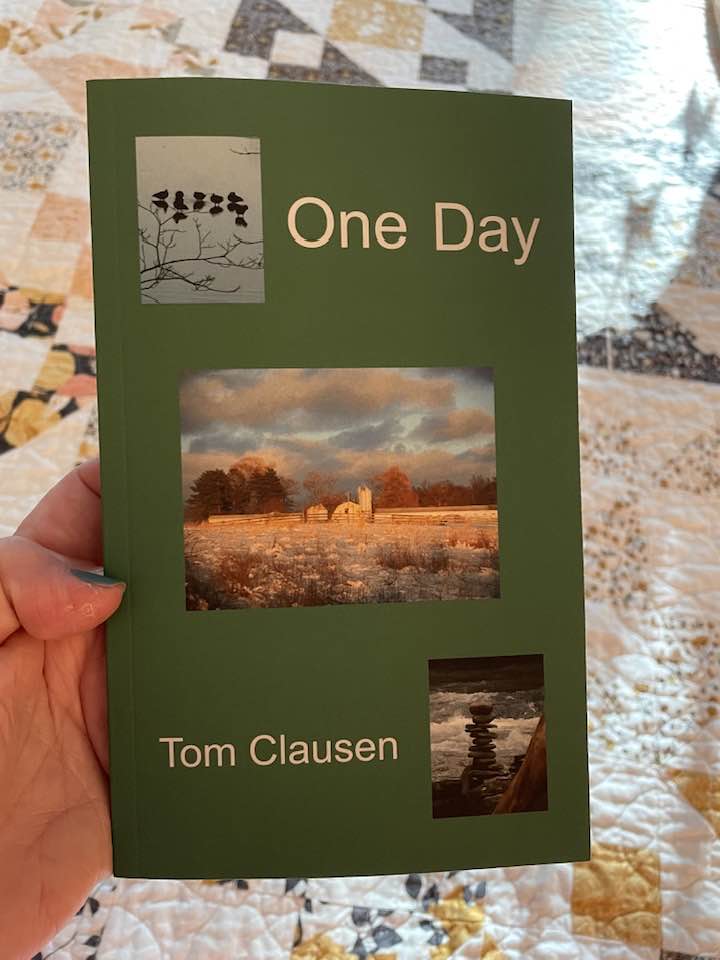
one day by tom clausen

11 Monday Dec 2023

Posted by Tom Clausen in Haiku Circle, Haiku Way of Life, One Day, photos, poems and photos, Published Poems, Tom Clausen biographical info, Tom poems at other sites, Tom selected favorites

≈ Leave a comment

Tags

Charlotte Digregorio's Writer's Blog, haiku, Haiku Circle, Larry Kimmel, little poems, nature, One Day, photography, photos, poetry, senryu, thirty years, vincent tripi

Daily Haiku Special: Dec. 11, 2023, New Book by Tom Clausen!

haiku poet interview with tom clausen

30 Tuesday May 2023

Posted by Tom Clausen in brass bell, Favorite Haiku, haiku, Haiku Way of Life, Published Poems, Tom Clausen biographical info, Tom poems at other sites, Tom selected favorites

≈ Leave a comment

Tags

biographical info, haiku, interview, poetry

Jacob Salzer conducts haiku poet interviews and here were my responses to questions
he asked:

https://haikupoetinterviews.wordpress.com/2022/08/01/tom-clausen/

tom clausen at living haiku anthology

26 Friday May 2023

Posted by Tom Clausen in americana, Favorite Haiku, haiku, Haiku Way of Life, Tom Clausen biographical info, Tom poems at other sites, Tom selected favorites

≈ Leave a comment

Tags

haiku, living haiku anthology, poetry, selected poems

sidewalk sale-
wind twists a lifetime
guarantee tag

Woodnotes

***

taking me back…
water laps gently
at the shore

Dim Sum


***

our turn
to stand here-
falls overlook

Frogpond


***

mountain brook-
       the indistinguishable spring
                     of voices

Mayfly


***

in the garden
sitting alone-
who i am now

Dim Sum


***

         in the dark
through the window light
     my wife and child

Modern Haiku


***

daybreak-
the spider centered
in its web

Dim Sum


***

long wait alone
in the parking lot…
a dog in the next car

Raw Nervz


***

on the way home
   more geese
      on the way home

Frogpond


***

returning the water
      from the vase
               to the flower garden

Dim Sum


***

letting her 
walk all over me
– ladybug

bottle rockets


***

potluck luncheon
a yellow jacket cleans
its antennae

Dim Sum


***


the cat’s eyes
so wide…
for a gnat

HN 2001 Members Anthology


***


undefended:
in the cold raiN
their snow fort

Frogpond


***


the way
rain takes
the mountain

Frogpond


***

Ducks riding the lake
brushed rough by wind;
pilings rimed with ice

Modern Haiku 1988


***


mountaintop:
giving back
each breath

Brussels Sprout   v.XI : no.1  Jan. 1994


***

lunch alone
without a book
i read my mind

Brussels Sprout  v.XI : no.1  Jan. 1994


***


rushing
 to the zendo to sit
still

Brussels Sprout  v.XI : no.2  May 1994


***

daybreak-
rubber duck alone
in the empty tub

Haiku Quarterly  summer 1994


***


on the trail again…
walking deeper
into myself

Frogpond  summer 1994


***

autumn moonlight
folded in
the clothes on the floor

Modern Haiku   summer 1994


***

the way
the light bulb rests
in the rest of the trash

Modern Haiku fall 1994


***

day break-
from the bread truck’s roof
frost swirls

Woodnotes  #25  


***

one tree
one bird, one song
the dusk

Frogpond  1995


***

x-ray room
they remove
her crucifix

Modern Haiku  fall 1995


***

alone in the waiting room
checking the plant
for reality

Woodnotes  1996


https://livinghaikuanthology.com/index-of-poets/213-c-poets/134-tom-clausen.html

Michelle Ground reviews nine haiku by tom clausen

19 Friday May 2023

Posted by Tom Clausen in Favorite Haiku, haiku, Haiku Way of Life, Tom Clausen biographical info, Tom poems at other sites, Tom selected favorites

≈ Leave a comment

Tags

haiku, poetry, reviews

Global Haiku Tradition
Millikin University, PACE Summer 2003

Michelle Ground
on

Tom Clausen’s Haiku

I picked Tom Clausen as my essay subject. I really like Tom’s haiku, they are very real and easy to understand and see the message he is portraying. He writes about events or moments that probably happen to most of us, but we just don’t realize it. Most of us, including myself, are so busy rushing around; we don’t stop to ‘smell the roses’. Tom’s haiku let me do just that. Reading some of them I thought to myself, ‘oh yeah I never realized that’. It was great. Tom has a way of capturing all the little events in life.

Tom Clausen grew up in Ithaca, New York. He works at his alma mater (1969-1973), Cornell University in the library. Before settling down with a family, Tom traveled Central and North America for 10 years. He did this by bicycle, bus, canoe, trains, cars, and by foot. Tom had always loved to write, but after having two children, he didn’t have the time to write as much and that is when he turned to haiku. He has published three chapbooks “Autumn Wind In the Cracks” (1994), “Unraked Leaves” (1995), “A Work of Love” (1997), and “Standing Here” (1998).

I have chosen nine of my favorite, and discussed why I like them and what they mean to me.

park twilight—
a light comes on
by itself

I like this one because I can just feel myself there alone, deep in thought, not noticing anything around me, and suddenly the park light comes on and you realize you have been there for quite awhile. Maybe even what I was in such deep thought about, finally becomes clear and I have and answer or understanding to the problem at hand. The light could represent the light going off in your head and you are say, “oh-yeah”.

standing here
at this window, remembering mother
standing here

This one is quite sad because he is remembering his mother who probably stood at that window many, many times. Maybe it is the kitchen window in her house and now she has passed on. This could be right after the funeral and he goes back to the house and is remembering all the things mother did. I have done this before when my daughter is at her dad’s house for the weekend. I am missing her so I will go sit on her bed and replay some of things she does in her room and it makes me smile. Hopefully this guy was smiling from happy memories of his mother standing there.

on the trail again . . .
walking deeper
into myself

This one is probably my favorite. I love going hiking in the woods; the smells, the sounds, the peaceful serenity of it. Even when I am with someone I find myself going into deep thought, and the more I walk the deeper in thought I go. Walking in the woods is very meditating for me. I find myself thinking of all kinds of things. Relationships, or what I want to do with my life. It’s great. I can just feel the coolness of the shade and the sunlight peeking through the trees every now and then. I can feel the bumpiness of the trail and having to concentrate on where I am walking or I will probably trip on a tree root and fall on my face. I can hear the birds singing and talking to each other, and something crackling in the leaves on the ground. I get nervous because I don’t know what or who is out there, but then it stops and I go on my merry way again. I feel as if summer is almost over and fall will soon begin because I can see the leaves turning colors slightly. Tom puts me in such peaceful mood reading this one. Good job Tom!

one tree
on bird, one song
the dusk

This one gives me the feeling of spring. The days are getting later and the birds are coming out and it is getting warmer. I can just hear the one bird singing his favorite song to me as the sun is going down. Maybe the bird is looking for a mate? I can see this being a pretty bird like a yellow finch, or a bright red cardinal. His brilliant colors making him stick on in this tree. After thinking about this one, I realized you usually only hear one bird at a time. I have a tree right outside my bedroom window and one bird usually serenades me. Only the bird is loud and doesn’t have a very pretty song to sing me at 6:00 in the morning. Tom gives me a sense of peace with this haiku also. I like the way he stops to notice the little things and to let his readers go there with him.

reading her letter—
suddenly aware of the look
on my face

I really like this one also. It paints a very vivid picture in my mind of a man reading a “Dear John” letter and his mouth is wide open with shock and despair that she is leaving him. He probably is rereading that one line over again that put that look on his face and then he thinks about it and realizes that he mouth is wide open and he hasn’t blinked for a minute. He shakes off the initial shock and then starts rereading again. I have done this people watching before, where I find myself staring at someone and then realizing my mouth is wide open, so I look around to see if anyone saw me and then I shake it off and try not to stare again. I get the feeling this is not a good newsletter and I feel sorry for the man reading it. He probably has to sit down to stop his knees giving out on him. I get the feeling his life is going to change drastically and that although sometimes that is good, I am not getting that feeling here.

back at the office
after sick leave—
watering her plant

This one is my office. If I were gone for a while, I would be lucky if my co-workers even noticed I was gone let alone water my plant. I don’t have any plants at work, but if I did they would be dead by the time I got back. This haiku made me chuckle. I can just picture this poor women coming back and the last thing she wants to see is her poor plant dying even though there is a sea of people around, no one was thoughtful enough to take care of her plant. Just goes to show that people are inconsiderate. I hope I am not this person and would water someone’s plant if they were gone.

twilight
the only car ahead
turns off

I picture this one as someone driving a long time to go see a loved one maybe and it is getting dark and they are in the middle of nowhere on a highway. They have been following this car for quite a ways and then this person has finally reached their destination and gets off and the driver of this car now is all by themselves; wishing they were at their destination. It is a very lonely haiku and we probably all know how this driver feels to be the only person on the road, just you and your thoughts. I do like this haiku though. It reminds me of when I drive the 5 hours to go see my mom and dad. It is light when I leave here and dark when I get there. By the time it hits twilight, I am ready to be out of the car and with my family.

a child standing guard
over a last little bit
of snow

This haiku reminds me of me when I was a kid and it had snowed and spring was coming so you knew this could be the last snow of the season. The sun is out and the snow is melting and this could be the snowman that was made and now the last of him is about to melt away. It represents to me a changing of the seasons, a long cold winter is turning into spring. I like this haiku because it has such an innocence to it. Like the child looking at the snow doesn’t realize that the snow will once again come next year. The child is probably sad that the snow is leaving us for warmer weather.

waiting to see
the odometer’s big change . . .
missed it!

I really like this haiku, it cracks me up because it is so true. I have done this many times before and have missed the big change and then I have to wait for the next big change. I don’t even notice how many miles are on my car, and then one day I will notice that I am close to another 10,000 miles, but then will forget to look again and the next time I look it will be over. I like this haiku because it tells me that I am not the only one who notices these little things in life.

Tom’s haiku have such an insight into everyday life. Most of us just go through the day without stopping to smell the roses, but Tom points these little things out, and it makes me stop to think about these little things of life. That is what I like. I have noticed since taking this class that I try and take notice of the little things that happen during the day, just to see if I can make a haiku about my day. I think that is what Tom has done, and I want to thank him for reminding me that it is the little things in life that are important.

—Michelle Ground

a bit of life by tom clausen

19 Saturday Oct 2019

Posted by Tom Clausen in cats, Frogpond, haiku, poems and photos, Published Poems, senryu, Tom poems at other sites

≈ Leave a comment

Tags

beer, cats, haiku, life, little poems, poems, poetry, senryu

frogpond vol. 41:3  fall 2018

giving a piece of cardboard
a bit of life
our cat

corner pub
my dark stout
in a Bud Lite glass

the way fir trees by tom clausen

19 Saturday Oct 2019

Posted by Tom Clausen in bottle rockets, haiku, poems and photos, Published Poems, Tom poems at other sites

≈ Leave a comment

Tags

bottle rockets, haiku, little poems, poems, poetry, sun, trees

bottle rockets  #31


in the heat
the way fir trees
bear the sun

anywhere by tom clausen

19 Saturday Oct 2019

Posted by Tom Clausen in bottle rockets, haiku, poems and photos, Published Poems, Tom poems at other sites

≈ Leave a comment

Tags

bottle rockets, haiku, little poems, poems, poetry

bottle rockets #35

eyes closed
i could be
anywhere

← Older posts

Recent Posts

  • brink of a breeze – tom clausen
  • Haiku by Agnes Savich, 11-26-26, at Mann Library
  • Haiku by Agnes Savich, 11-25-26, at Mann Library
  • frosty morning – tom clausen
  • Haiku by Agnes Savich, 11-24-26, at Mann Library

Categories

  • A Work of Love (46)
  • abandoned buildings (26)
  • Akitsu Quarterly (8)
  • American Haibun & Haiga (3)
  • americana (832)
  • autumn (270)
  • barns (21)
  • bees (24)
  • bicycles and cycling (5)
  • birds (48)
  • Book reviews (8)
  • bottle rockets (8)
  • brass bell (4)
  • bunnies-rabbits (5)
  • butterflies (12)
  • cats (12)
  • cemeteries (9)
  • Chapbooks (9)
  • close up details (798)
  • clouds (123)
  • Cornell (31)
  • deer (52)
  • Dim Sum (33)
  • dogs (10)
  • dragonflies (8)
  • Favorite Haiku (13)
  • fields (165)
  • flowers (201)
  • forests (49)
  • Frogpond (24)
  • frogs (11)
  • fungus (31)
  • gardens (100)
  • gorges (67)
  • Gusts (8)
  • haibun (5)
  • haiku (914)
  • Haiku Circle (3)
  • Haiku Poets at Mann Library (2)
  • Haiku Way of Life (18)
  • hedgerow (3)
  • Heron's Nest (6)
  • hills and mountains (42)
  • horses (2)
  • Hummingbird (1)
  • ice (31)
  • insects (6)
  • Interviews (2)
  • Ithaca (405)
  • lakes and rivers (102)
  • landscapes (333)
  • Laughing To Myself (4)
  • leaves (200)
  • lichen (2)
  • light (88)
  • Lynx,, tanka (3)
  • mailboxes (4)
  • Mann Library Daily Haiku (322)
  • Mayfly (1)
  • Mexico (3)
  • milkweed (14)
  • Modern Haiku (26)
  • moon (18)
  • nature (1,118)
  • ocean imagery (13)
  • Old Vehicles (11)
  • One Day (5)
  • otata (1)
  • parks (105)
  • paths (199)
  • Peru (21)
  • photos (802)
  • plants (311)
  • poems and photos (1,683)
  • ponds (49)
  • Published Poems (377)
  • puddles (20)
  • raindrops (11)
  • Readings (7)
  • reflections (68)
  • roads (50)
  • rust (9)
  • sea shore (3)
  • senryu (78)
  • shadows (13)
  • snakes (7)
  • snow (94)
  • South by South East (1)
  • spring (275)
  • squirrels (11)
  • summer (325)
  • sun (71)
  • sunsets (43)
  • tanka (129)
  • Tom Clausen biographical info (16)
  • Tom poems at other sites (19)
  • Tom selected favorites (23)
  • trains (21)
  • trees (283)
  • turtles (9)
  • vines (28)
  • Wabi Sabi (211)
  • water reflections (135)
  • waterfalls (40)
  • wild graces (1)
  • Willy the Beeman (1)
  • winter (205)
  • Woodnotes (1)

Published poems

  • Modern Haiku
  • Akitsu Quarterly
  • ephemerae
  • Mayfly
  • Frogpond
  • Heron’s Nest
  • Woodnotes
  • Gusts
  • red lights
  • Haiku Canada
  • Raw Nervz
  • American Tanka
  • Dim Sum
  • Haiku Headlines
  • Ribbons
  • Haiku Quarterly
  • bottle rockets
  • South by Southeast
  • black bough
  • Heron’s Nest
  • Frogpond
  • Akitsu Quarterly
  • Modern Haiku
  • Mayfly
  • Haiku Canada

Archives

  • November 2026
  • October 2026
  • September 2026
  • August 2026
  • July 2026
  • June 2026
  • May 2026
  • April 2026
  • March 2026
  • February 2026
  • January 2026
  • December 2025
  • November 2025
  • August 2024
  • July 2024
  • June 2024
  • May 2024
  • April 2024
  • March 2024
  • February 2024
  • January 2024
  • December 2023
  • November 2023
  • October 2023
  • September 2023
  • August 2023
  • July 2023
  • June 2023
  • May 2023
  • April 2023
  • September 2022
  • July 2022
  • June 2022
  • May 2022
  • November 2021
  • October 2021
  • September 2021
  • July 2021
  • April 2020
  • December 2019
  • November 2019
  • October 2019
  • April 2019
  • March 2019
  • December 2018
  • November 2018
  • October 2018
  • September 2018
  • June 2018
  • April 2018
  • March 2018
  • January 2018
  • December 2017
  • October 2017
  • September 2017
  • June 2017
  • May 2017
  • April 2017
  • March 2017
  • January 2017
  • December 2016
  • November 2016
  • October 2016
  • September 2016
  • August 2016
  • June 2016
  • December 2015
  • October 2015
  • September 2015
  • August 2015
  • July 2015
  • June 2015
  • May 2015
  • April 2015
  • March 2015
  • February 2015
  • January 2015
  • August 2014
  • March 2014
  • February 2014
  • January 2014
  • December 2013

Recent Comments

Ezekiel Fish's avatarEzekiel Fish on over the dam – tom …
Tom Clausen's avatarTom Clausen on over the dam – tom …
Ezekiel Fish's avatarEzekiel Fish on over the dam – tom …
Ezekiel Fish's avatarEzekiel Fish on overnight rain – tom…

Meta

  • Create account
  • Log in
  • Entries feed
  • Comments feed
  • WordPress.com

Categories

  • A Work of Love (46)
  • abandoned buildings (26)
  • Akitsu Quarterly (8)
  • American Haibun & Haiga (3)
  • americana (832)
  • autumn (270)
  • barns (21)
  • bees (24)
  • bicycles and cycling (5)
  • birds (48)
  • Book reviews (8)
  • bottle rockets (8)
  • brass bell (4)
  • bunnies-rabbits (5)
  • butterflies (12)
  • cats (12)
  • cemeteries (9)
  • Chapbooks (9)
  • close up details (798)
  • clouds (123)
  • Cornell (31)
  • deer (52)
  • Dim Sum (33)
  • dogs (10)
  • dragonflies (8)
  • Favorite Haiku (13)
  • fields (165)
  • flowers (201)
  • forests (49)
  • Frogpond (24)
  • frogs (11)
  • fungus (31)
  • gardens (100)
  • gorges (67)
  • Gusts (8)
  • haibun (5)
  • haiku (914)
  • Haiku Circle (3)
  • Haiku Poets at Mann Library (2)
  • Haiku Way of Life (18)
  • hedgerow (3)
  • Heron's Nest (6)
  • hills and mountains (42)
  • horses (2)
  • Hummingbird (1)
  • ice (31)
  • insects (6)
  • Interviews (2)
  • Ithaca (405)
  • lakes and rivers (102)
  • landscapes (333)
  • Laughing To Myself (4)
  • leaves (200)
  • lichen (2)
  • light (88)
  • Lynx,, tanka (3)
  • mailboxes (4)
  • Mann Library Daily Haiku (322)
  • Mayfly (1)
  • Mexico (3)
  • milkweed (14)
  • Modern Haiku (26)
  • moon (18)
  • nature (1,118)
  • ocean imagery (13)
  • Old Vehicles (11)
  • One Day (5)
  • otata (1)
  • parks (105)
  • paths (199)
  • Peru (21)
  • photos (802)
  • plants (311)
  • poems and photos (1,683)
  • ponds (49)
  • Published Poems (377)
  • puddles (20)
  • raindrops (11)
  • Readings (7)
  • reflections (68)
  • roads (50)
  • rust (9)
  • sea shore (3)
  • senryu (78)
  • shadows (13)
  • snakes (7)
  • snow (94)
  • South by South East (1)
  • spring (275)
  • squirrels (11)
  • summer (325)
  • sun (71)
  • sunsets (43)
  • tanka (129)
  • Tom Clausen biographical info (16)
  • Tom poems at other sites (19)
  • Tom selected favorites (23)
  • trains (21)
  • trees (283)
  • turtles (9)
  • vines (28)
  • Wabi Sabi (211)
  • water reflections (135)
  • waterfalls (40)
  • wild graces (1)
  • Willy the Beeman (1)
  • winter (205)
  • Woodnotes (1)

Archives

  • November 2026
  • October 2026
  • September 2026
  • August 2026
  • July 2026
  • June 2026
  • May 2026
  • April 2026
  • March 2026
  • February 2026
  • January 2026
  • December 2025
  • November 2025
  • August 2024
  • July 2024
  • June 2024
  • May 2024
  • April 2024
  • March 2024
  • February 2024
  • January 2024
  • December 2023
  • November 2023
  • October 2023
  • September 2023
  • August 2023
  • July 2023
  • June 2023
  • May 2023
  • April 2023
  • September 2022
  • July 2022
  • June 2022
  • May 2022
  • November 2021
  • October 2021
  • September 2021
  • July 2021
  • April 2020
  • December 2019
  • November 2019
  • October 2019
  • April 2019
  • March 2019
  • December 2018
  • November 2018
  • October 2018
  • September 2018
  • June 2018
  • April 2018
  • March 2018
  • January 2018
  • December 2017
  • October 2017
  • September 2017
  • June 2017
  • May 2017
  • April 2017
  • March 2017
  • January 2017
  • December 2016
  • November 2016
  • October 2016
  • September 2016
  • August 2016
  • June 2016
  • December 2015
  • October 2015
  • September 2015
  • August 2015
  • July 2015
  • June 2015
  • May 2015
  • April 2015
  • March 2015
  • February 2015
  • January 2015
  • August 2014
  • March 2014
  • February 2014
  • January 2014
  • December 2013
Follow tom clausen on WordPress.com

Recent Comments

Ezekiel Fish's avatarEzekiel Fish on over the dam – tom …
Tom Clausen's avatarTom Clausen on over the dam – tom …
Ezekiel Fish's avatarEzekiel Fish on over the dam – tom …
Ezekiel Fish's avatarEzekiel Fish on overnight rain – tom…

Meta

  • Create account
  • Log in
  • Entries feed
  • Comments feed
  • WordPress.com

Blog at WordPress.com.

  • Subscribe Subscribed
    tom clausen
    Join 445 other subscribers

    Have a WordPress.com account? Log in now.

  • tom clausen
    View site in Reader
    Manage subscriptionsSign upLog in
    Report this content
    Collapse this bar
Loading Comments...